

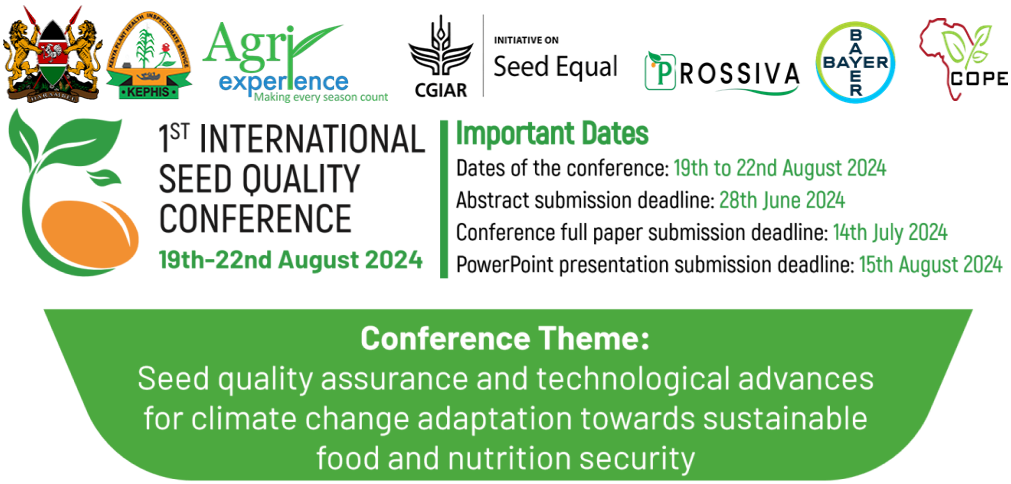
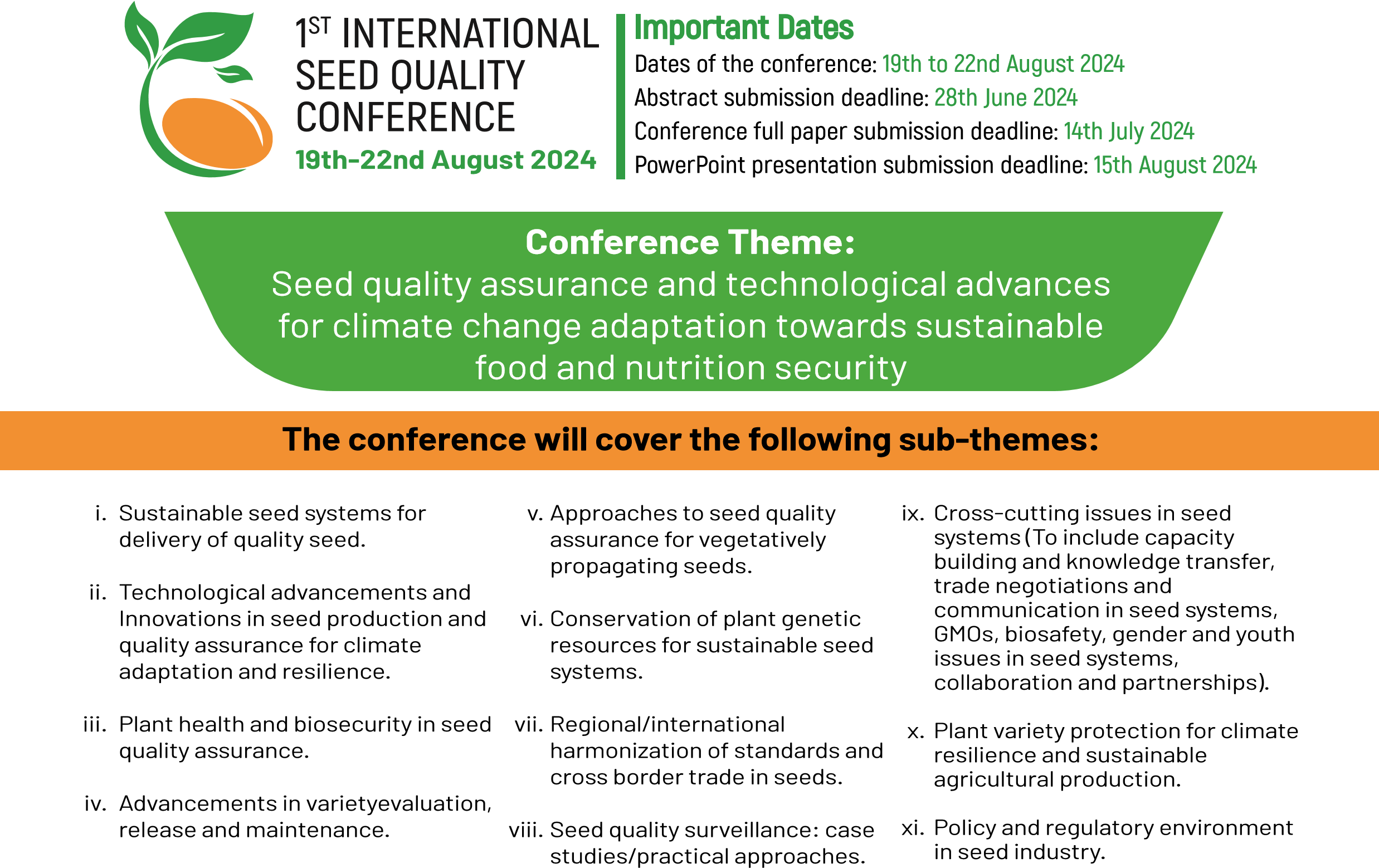
The 1st International Seed Conference







Single Registration
4th Phytosanitary Conference - 2023
KEPHIS is spearheading activities to mark the International Year of Plant Health (2023/2024) in Kenya. KEPHIS and COPE have organized a virtual 4th Phytosanitary Conference from 18th to 21st September 2023 in Nairobi, Kenya. The theme of the conference is “Enhancing Phytosanitary Systems for Healthy Plants, Safe and Sustainable Trade”. This Conference will be in line with the celebrations of the International Year of Plant Health in 2023/2024.
CONFERENCE REGISTRATION FEES (to include abstract book, conference proceedings and current phytosanitary journal)
The bank deposit slip should be scanned and forwarded to the email: This email address is being protected from spambots. You need JavaScript enabled to view it.. Registration confirmation/receipt and further information will be emailed to you upon receipt.
If you have any questions, please call e-mail the conference secretariat on: This email address is being protected from spambots. You need JavaScript enabled to view it. or This email address is being protected from spambots. You need JavaScript enabled to view it.
Event Information
| Event Date | 09-18-2023 |
| Event End Date | 09-21-2023 |
| Capacity | Unlimited |
| Registered | 253 |
| Cut off date | 09-21-2023 |
| Individual Price | Students: US$ 150 | Corporate Delegate (Maximum Three Participants) US$ 750 |
Introduction to International Treaties and Standards in Phytosanitary systems
To create awareness and enhance knowledge on:
- WTO-SPS agreement
- The role of IPPC in regulating Phytosanitary issues
- The use of ISPMs in Phytosanitary systems
- The existing national and regional phytosanitary frameworks
- The private standards, other international standards and treaties that are linked to agricultural trade and plant health
- World Trade Organization – Sanitary and Phytosanitary (WTO-SPS) Agreement
- The International Plant Protection Convention (IPPC)
- International Standards on Phytosanitary Measures (ISPMs)
- National and regional phytosanitary frameworks
- Private standards that are linked to trade and plant health
- International standards and treaties linked to trade and plant health
1.3.1 WTO-SPS Agreement (5 Hours)
- Introduce WTO and WTO-SPS agreement: background of the WTO, WTO structure, WTO SPS Agreements, role of IPPC, Codex and OIE standard setting bodies (the ‘3 sisters’), Technical Barriers to Trade (TBT), Non-Technical Barriers to Trade (NTB) and Sanitary and Phytosanitary measures (SPS) .
- The WTO-SPS committee: membership, roles and responsibilities, structure, role of the Institute for Training and Technical Cooperation (ITTC) in national, regional and international training.
- WTO-SPS agreement:- principles and articles in the agreement; general provisions, basic rights and obligations, risk assessment, non-discrimination, equivalence, scientific justification, technical assistance, harmonization, transparency [including SPS-IMS], regionalization, SPS notifications, dispute resolution [including legal assistance – Advisory Center on WTO law – ACWL] and others.
- Standards and Trade Development Facility (STDF): Background, structure, roles of STDF such as funding for Phytosanitary capacity building, conferences, funding procedures and examples of funded projects like COPE, Uganda-Floriculture, COMESA-Breaking Barriers Project.
- Practical Case studies - ‘Trading Safely’ video; WTO case studies – major decisions and reference documents for WTO; major trade disputes (WTO dispute settlement and agreement: index of list, current issues on WTO SPS agreements) and how they have been resolved.
- Exercises: Notifications using the SPS-IMS; quizzes on different aspects of WTO SPS agreements, TBT and NTB measures; dispute resolution like role playing on principles of negotiation.
- Introduction to IPPC: Background, membership, functions, contracting parties obligations, country compliance, Phytosanitary Capacity Evaluation (PCE) and impact on national and international trade, ISPM No. 1 and 5.
- IPPC administrative framework: Commission on Phytosanitary Measures (CPM), Standards Committee (SC), Subsidiary body on dispute settlement, strategic planning and technical assistance.
- International Plant Protection (IPP) Portal: role in exchange of information and implementation of standards.
- IPPC standard setting process: steps in standards development, technical panels (expert working groups), and adoption of IPPC standards.
- Scope and objectives of the International Standards for Phytosanitary Measures (ISPMs)
- Dispute settlement: procedures, informal and formal consultations, selection of dispute settlement procedure, formation of expert committee, report preparation, others; examples of IPPC mediated disputes and their resolution.
- Exercises: visit the IPPC website and download information including ISPM updates, technical assistance, new pest reports, contact points, and preparation of country member comments; discussion on dispute settlement, and other relevant exercises.
- Overview of the adopted ISPMs (ISPM 1-41)
- ISPM development process
- Groupings ISPM based on application: pest risk analysis (PRA), imports, exports, pathways, surveillance, pest free areas and areas of low pest prevalence, diagnostic protocols and pest reporting, phytosanitary treatments,
- National Plant Protection Organization (NPPO): formation, framework and responsibilities, ISPM implementation, opportunities for member participation, member consultation process.
- National coordination mechanism: national coordinating committees, international trade, notifications and communications’ structure.
- Regional coordination mechanisms: Phytosanitary agreements, harmonization of regional standards, one border concept, migration to single window for increased trade (COMESA, EAC, Inter-Africa Phytosanitary Commission (IAPSC), SADC, ECOWAS, NAPPO, EPPO-); COMESA green pass (green channel) and Phytosanitary issues in the implementation of guidelines to alleviate bottle necks to regional trade; global trends on information sharing cross border information exchange for regional integration and role of state agencies and private sector, and other new phytosanitary regulation
- Other standards: National standards for different countries, for example fruits and vegetable standards;Kenya Bureau of Standards (KEBS) standards and Horticultural Crop Directorate (HCD) code of conduct for Kenya and equivalent for other participating countries; traders associations and horticultural producers associations, grain traders associations and capacity building initiatives.
- Exercises: Group discussions and presentations on the national phytosanitary framework and codes of conduct for fruits, vegetables, grains, seeds or flowers by participants from different countries represented in the training.
The details of the topic will be tailor-made to the Countries represented in the training
- Types of private standards, importance, concerns and implications; harmonization (bench marking), equivalence, transparency, control, inspection, approval procedures, consultation/appeal mechanisms.
- Position of SPS committee on private standards- status of private standards in WTO, relations, rules and disputes
- Examples of international and national private standards: – GlobalGAP, Tesco’s Natures choice, BRC, Fairtrade labeling organization (FLO), SAI, RSPO, BCI, BSCI, FSC, UTZ certified, KenyaGap, KFC code of conduct, ISO and others.
- Case studies: impact of a particular private standard on trade and plant health
- Exercises – Group discussions on advantages and disadvantages of private standards, different country experiences, role plays or simulation exercises, and proposed solutions/impacts, presentations on equivalent standards used in different countries participating in the training.
- Convention on Biological Diversity (CBD): Background, Cartagena Protocol and its effects on international trade, Nagoya protocol on access and benefit sharing
- The Convention on International Trade in Endangered Species of Wild Fauna and Flora (CITES): Convention on International Trade in Endangered Species of Wild Fauna and Flora
- The International Union for the Protection of New Varieties of Plants (UPOV): Background, membership, guidelines and effects on international trade
- Codex Alimentarius Commission (CODEX): Background, membership, CODEX Food Standards and effects on international trade, Maximum Residual Limita (MRLs)
- The Organization for Economic Co-operation and Development (OECD) Background, membership, different schemes and effects on international trade
- United Nations Economic Commission for Europe (UNECE):: Background, membership, UNECE standards for fruits and vegetables and effects on international trade
- International Seed Testing Association (ISTA): Background, membership, role in seed certification and effects on international trade.
- International Organization for Standardization (ISO): Background, membership, role in setting international standards, examples (17025, 22000, 9001, 17020 and others), importance in international trade
- Case studies: Impact of certain standards trade, plant health and food security for example UNECE, ISTA and CBD
- Exercises: Identify problems from participants’ countries and relate to any of the above standards (country group discussions), comparison between private and international standards.
- The International Plant Protection Convention (IPPC) website: http://www.ippc.int/
- The WTO Agreement on the Application of Sanitary and Phytosanitary Measures (SPS Agreement). http://www.wto.org/english/tratop_e/sps_e/spsagr_e.htm
- Convention on Biological Diversity(CBD). http://www.cbd.int/convention/articles.shtml?a=cbd-00
- The Convention on International Trade in Endangered Species of Wild Fauna and Flora. https://www.cites.org/
- The Cartagena Protocol on Biosafety. http://bch.cbd.int/protocol/
- Crop Protection Compendium. http://www.cabi.org/cpc/
- World Trade Organization. www.wto.org
- The Organization for Economic Co-operation and Development (OECD) http://www.oecd.org/home/0,2987,en_2649_201185_1_1_1_1_1,00.html
- International Seed Testing Association (ISTA). http://www.seedtest.org/en/home.html
- International Organization for Standardization (ISO). http://www.iso.org/iso/home.html
- United Nations Economic Commission for Europe (UNECE). http://www.unece.org/
- GlobalGAP. http://www.globalgap.org/cms/front_content.php?idcat=9
- Fairtrade Labelling Organizations International (FLO). http://www.fairtrade.net/
- Inter-African Phytosanitary Council (IAPSC). http://r4dreview.org/2011/04/iapsc-protecting-africas-plant-health/
- The Southern African Development Community (SADC). www.sadc.int/
- Common Market for Eastern and Southern Africa (COMESA). www.comesa.int/
- The Standards and Trade Development Facility (STDF). http://www.standardsfacility.org/en/index.htm
- CODEX Alimentarius. Current Official Standards. http://www.codexalimentarius.net/web/standard_list.jsp
- World Organization for Animal Health (OIE). http://www.oie.int/
- World Trade Organization, May 2009, Committee on Sanitary and Phytosanitary Measures; Reference documents; World Trade Organisation, Geneva Switzerland.
- World Trade Organization, September 2011, Committee on Sanitary and Phytosanitary Measures; Major Decisions and Documents; World Trade Organization, Geneva Switzerland.
- World Trade Organisation, 2010, Committee on Sanitary and Phytosanitary Measures; the WTO Agreements Series, Sanitary and Phytosanitary Measures; World Trade Organization, Geneva Switzerland.
- Common Market for Eastern and Sothern Africa; Protocol on rules of origin, Common Market for Eastern and Southern Africa, Lusaka Zambia.
- World Trade Organization, February 2009, Committee on Sanitary and Phytosanitary Measures; Procedural Step by Step Manual for SPS National Notification Authorities and SPS National Enquiry points; World Trade Organisation, Geneva Switzerland.
- World Organization for Animal Health (OIE). http://www.oie.int/
- WTO Publications online https://www.wto.org/english/res_e/publications_e/publications_e.htm
- IPPC publications: www.IPPC.int
- EAC SPS Protocol: https://www.eac.int/
- The International Union for the Protection of New Varieties of Plants (UPOV). https://www.upov.int/portal/index.html.en
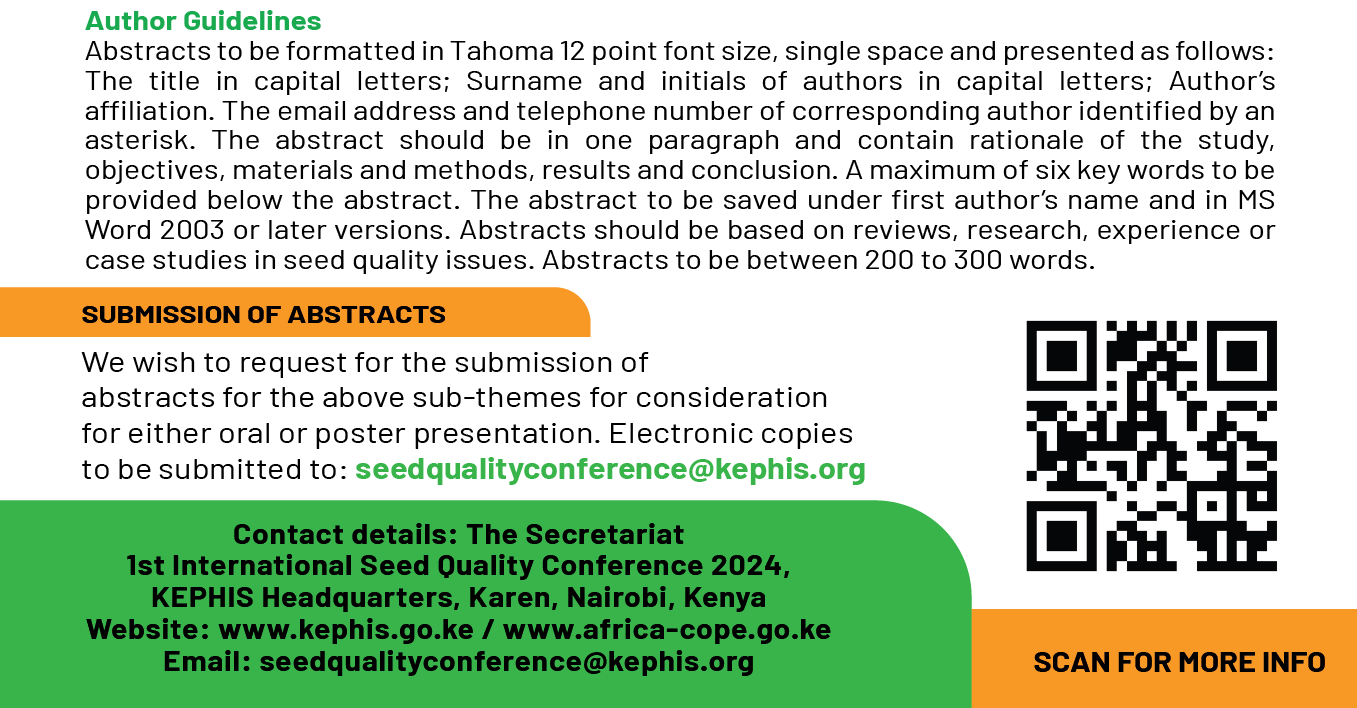
Call for Abstracts
THE 3rd INTERNATIONAL PHYTOSANITARY CONFERENCE 2021 (Virtual Edition)
13th to 16th September 2021; KEPHIS, Nairobi, Kenya
Important Dates:
Dates of the conference: 13th to 16th September 2021
Abstract submission deadline: 15th August 2021
Conference full paper submission deadline: 31st August 2021
Overall Theme of the Conference:
"Enhancing Phytosanitary Systems for Healthy Plants, Safe and Sustainable Trade"
The scope of this conference will cover the following sub-themes:
- International Year of Plant Health
- Pest Surveillance in Phytosanitary Systems
- Import control and Quarantine Regulations
- Pest diagnostics in phytosanitary systems
- Export certification in phytosanitary systems
- Emerging innovationPhytosanitary systems
- Industry role in the implementation of successful phytosanitary systems
- Capacity building, regulatory framework, trade negotiations, and communication in phytosanitary systems
DOWNLOAD GUIDELINES FOR ABSTRACT WRITING
3rd Phytosanitary Conference Presentations

Day One | 13th September 2021
Day 1 Plenary Sessions
- Natural Enemies and Potential Classical Biological Control of Invasive Scale Insects (Hemiptera: Coccomorpha) in Sub-Saharan Africa Andrew Polaszek
- Overview of CABI Global Programmes CABI Special Session
- Mitigation Measures for Invasive Insect Pests on Eucalyptus spp. in East Africa: A Review Eston Mutitu
- Some Invasive Scale Insects (Hemiptera: Coccomorpha) Spreading in Africa Gillian Watson
- International Year of Plant Health - Kenya Report Hellen Mwarey
- The International Day of Plant Health Championed by Zambia Martin Siazemo
- Occurrence of Pectobacterium Species in Soil Collected From Six Major Potato Growing Regions of Kenya Lucy Karanja
- Keynote Speech Ralf Lopian - IYPH
- Extensive Surveillance of Key Potato Growing Areas in Kenya Confirms Absence of Clavibacter Sepedonicus Rono Mercy
Day 1 Room 1
- Biosecurity Threat Posed by Evolving Pest Incursions in KenyanThomas Kosiom
- Plant Post-Entry Quarantine Regulations in Kenya: Current Status and Future Prospects Avedi Edith
- Status of Tomato Brown Rugose Fruit Virus Disease in Tomato and Capsicum Crops in Kenya Avedi et al Final
- Reimagining the e-market: The role of Kenya Plant Health Inspectorate Service (KEPHIS) in regulating trade of plant products on the online market in Kenya Miriam Karwitha Charimbu
- Electronic Certification: Improving Phytosanitary Systems for Healthy Plants, Safe and Sustainable Trade – Case Review Josiah Syanda
- Importance of Accreditation of Plant Health Laboratories in Supporting Phytosanitary Systems Florence Munguti
- Biosecurity Threat Posed by Evolving Pest Incursions in Kenyan Thomas Kosiom
Day 1 Room 2
- Virus Elimination in Cassava Clones and Maintenance of Clean Stock Dr. Morag Ferguson
- Efficacy of Nonoencapsulated Thymol and Eugenol with Chitosan Nanoparticles against Bacterial Wilt Bacterium Ralstonia solanacearum George Oluoch
- Infestation and management of fruitflies infesting African bird eye chili (Capsicum frutescens L.) in coastal Kenya Muo KASINA
- A distinct variant of Groundnut rosette virus associated satellite RNA (Sat-RNA) causing chlorotic rosette in western Kenya Mukoye Bernard
- Evaluation of Periphos 77.5 GR in Fumigation of Roses for Management of Thrips (Frankliniella Occidentalis), Red Spider Mites (Tetranychus Urticae) and False Codling Moth (Thaumatotibia Leucotreta) Mulwa Joseph

Day Two | 14th September 2021
Day 2 Plenary Sessions
- Surveillance on Coconut Lethal Yellowing Disease in Kwale County, Kenya. John Muli
- Tree seed-borne fungal pathogens associated with Mwangi Linus
- Rapid molecular identification of thrips transmitting maize infecting viruses in Murang’a County of Kenya Paul Nyamwamu
- Botryosphaeria Canker and Dieback a Threat to Domestication of Baobab (Adansonia Digitata L.) and Marula (Sclerocarya Birrea A. Rich.) In Agroforestry Systems in Kenya Sheillah Cherotich
- HEAD NPPO Raymonda Johnson
Day 2 Room 1
- Status of Tomato Brown Rugose Fruit Virus Disease in Tomato and Capsicum Crops an Kenya Avedi Edith
- Characterization of the genetic diversity of Cercospora zeina as the causal pathogen of Gray Leaf Spot disease of maize in Kenya. Dennis Omondi
- Incidence and Distribution of Cassava Mosaic and Cassava Brown Streak Diseases in Western Kenya Ivan Obare
- Epiphytology and Genomic RNA Analysis of Groundnut Rosette Assistor Virus Causing Groundnut Rosette Disease in Western Kenya Mabele Anthony
- On-Field Detection of The Genus Pectobacterium and Dickeya Causing Black Leg in Taita Taveta County, Kenya Cyrus Micheni
- Assessment and Detection of Maize Chlorotic Mottle Virus Stability in Maize Seeds in Kenya Peter Shango
Day 2 Room 2
- Surveillance of Papaya Mealybug (Paracoccus marginatus) (Hemiptera: Pseudococidae) in the coastal counties of Kenya - Alfayo Ombuya
- Bacterial Wilt in Potato: Disease Prevalence, Incidence and Severity in Kenya - Bernard Kharinda
- Diversity of nematodes of banana (Musa spp.) in Kenya with reference to altitude and banana types - Douglas Nyang'au
- Drosophila Suzukii Matsumura (Spotted Wing Drosophila) Incidence and Prevalence Surveys in Kenya - George Momanyi
- TRASE: Capacity building programmes towards strengthening regulatory and industr y capacity on Phytosanitary surveillance, Inspection & Market compliance in East African Community - Martha Byanyima

Day Three | 15th September 2021
Day 3 Plenary Sessions
- Integrated management of Leucinodes orbonalis on eggplant fruits exported to European UnionADZE AUGUSTIN
- The case of market access of fresh blueberry fruits produced by Zambezi Berry Company in Zambia to ChinaEmma Mazimba Sikazwe
- Capacity building towards implementation of Sanitary and Phytosanitary Standards for market compliant agricultural produceJoseph Kigamwa
- Key Note SpeechDr. Kk Msiska
- Scale Insects: Distribution and Threat to Food Security in KenyaWanja Kinuthia
- Phytosanitary and Risk Assessment Considerations during Introduction and Cross-border Movement of Transgenic CropsAbed Mathagu
Day 3 Room 1
- Pathways Threatening Alien Pest Entry Through Border Points into KenyaBenard Mukoye
- IntegratedADZE
- Evaluation of pesticide residues in pigeon peas and its effects on honey bee floral resources in Machakos county.Rosemary Kawira Mutiga
- Effects of Biofumigation of Spider Plant (Cleome Gynandra L.) Against Root-Knot Nematodes (Meloidogyne Spp.) On Quality of Tuberose (Polianthes Tuberosa L.)Stella Jerono Keter
- Assessment of Xylella fastidiosa presence in flower cuttings and potential host plants of UgandaStephen Buah
- Phytosanitary Concern of Fumigation Gaps in International Trade in GrainsThomas Kosiom
Day 3 Room 2
- Partnering with the Private sector to restore Mango exports to the EU and UK Markets.Geoffrey Kiganiri
- Effects of changes in market requirements: A Case Study of Current Status of Compliance of Kenyan Produce in the International MarketMary Guantai
- Farming practices and soil properties that influence spread and population density of potato cyst nematodes in smallholder farms in Nyandarua CountyMbiyu M. W.
- Systems Approach for the Management of Fruit fly Bactrocera dorsalis for Kenya Mango ExportPhyllis Githaiga
- Public And Private Sector Capacity Building Interventions to Improve Compliance to Sanitary Phytosanitary Standards in Fruits and Vegetable Growers in UgandaNankinga Caroline

Day Four | 16th September 2021
Day 4 Plenary Sessions
- Integrated Pest Management Decision Support System (IPMDSS) Using technology to manage tree diseases and pests in KenyaAngela Muthama
- Rôle de l'industrie et innovations émergentes dans les systèmes phytosanitairesSylvie Mamias
- Horizon scanning for prioritizing invasive alien species with potential to threaten Kenya’s agriculture, biodiversity and economyGeorge Momanyi
- Deploying Low-cost pest exclusion agricultural nets to manage problematic horticultural pests for sustainable export market accessMuo KASINA
- KEY NOTE SPEECHDR. KENNETH K. MSISKA
- Horizon Scanning and Insight Reporting for Monitoring and Managing Phytosanitary RisksMaryLucy Oronje
- Emerging Innovation in Phytosanitary Systems for Control of Invasive Papaya Mealybug, Paracoccus Marginatus, in Kenya Coast RegionPauline Mukumbu
- Advances in non-chemical Post Hervest Disinfestation of Fruits and Vegetables using Hot Water Treatment Phytosanitary Measures: Status and Future Shephard Ndlela
- Effectiveness of Imazapyr Coated Hybrids and Selected Strigatolerant Varieties on S. hermonthica Management and Maize Yield Performance in Western Part of KenyaSamwel Mwita
- Industry Role and Emerging Innovations in Phytosanitary SystemsSylvie Mamias
Day 4 Room 1
- Novel Approach in Management of fall Armyworm (Spodoptera frugiperda JE Smith) using various Extracts from larvae treated with baculovirus Allan Mweke
- Efficacy of Organic Amendments in the Control of Potato Cyst Nematodes Under Greenhouse Conditions in KenyaBerrick Ochieng
- The role of regulatory institutions in safeguarding consumers against aflatoxin exposure: a case of KEPHISEdmond Momanyi
- Red Gum Lerp Psyllid (Glycaspis Brimblecombei) Spread, Host Damage and Host Preference in Central Kenya HighlandsMiriam Gathogo
- Knowledge Gap Assessment and Coping Strategies by Farmers Against Fall Armyworm (Spodoptera frugiperda J.E. Smith) Infesting Maize in South Eastern and Coastal KenyaBoniface Mwirigi
- Integrated Pest Management of fruit flies in Machakos County in Kenya improves overall yield of pumpkinAlice Nduta Waithaka
- Evidence of Natural Attack of Fall Armyworm, Spodoptera frugiperda (J.E. Smith) by Parasitoids and Entomopathogens in Southeastern KenyaName
Day 4 Room 2
- Partnering with the Private sector to restore Mango exports to the EU and UK Markets.Geoffrey Kiganiri
- Effects of changes in market requirements: A Case Study of Current Status of Compliance of Kenyan Produce in the International MarketMary Guantai
- Farming practices and soil properties that influence spread and population density of potato cyst nematodes in smallholder farms in Nyandarua CountyMbiyu M. W.
- Systems Approach for the Management of Fruit fly Bactrocera dorsalis for Kenya Mango ExportPhyllis Githaiga
- Public And Private Sector Capacity Building Interventions to Improve Compliance to Sanitary Phytosanitary Standards in Fruits and Vegetable Growers in UgandaNankinga Caroline